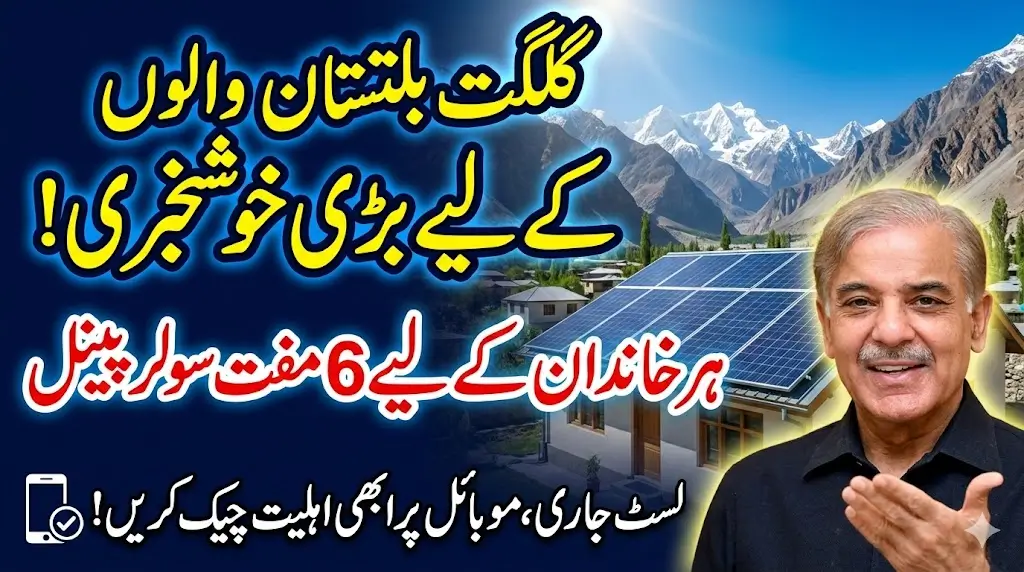
How Many Solar Panels Can Families in Gilgit-Baltistan
How Many Solar Panels Can Families in Gilgit-Baltistan: Access to reliable electricity has long been a challenge for many communities living in remote mountainous regions. To address this issue, the government has introduced a solar energy initiative specifically designed for families living in Gilgit-Baltistan. This program focuses on promoting renewable energy while ensuring that households in distant areas receive a stable and affordable power source.

Through this initiative, eligible families can receive a small solar system that allows them to power basic household appliances such as lights, fans, and mobile charging devices. The program is designed to reduce reliance on traditional electricity sources and help communities adopt sustainable energy solutions that work effectively in areas where the power grid is limited or unreliable.
You Can Also Read: Shahbaz Sharif Gb Solar Scheme Online Application Status Check Via CNIC Number
Maximum Number of Solar Panels Provided to Each Family
Under the current distribution plan, families who successfully complete the registration process may receive up to six solar panels as part of the free solar system package. These panels are provided based on the household’s eligibility and the results of the verification process conducted by officials after registration.
The solar units are designed to generate enough electricity for essential daily needs. While the exact configuration of the system may vary depending on the household’s requirements, the maximum limit set for most eligible families is six plates. This allocation ensures that each household receives a balanced system capable of supporting basic energy consumption in rural environments.
| Program Feature | Details |
|---|---|
| Target Area | Gilgit-Baltistan (Remote & mountainous regions) |
| Max Panels per Family | Up to 6 solar panels |
| System Cost | Completely free for selected families |
| Current Phase | Phase 1 registration completed |
| Next Verification Step | Physical household survey |
| Status Check | Available via the official online portal |
First Phase of Registration Completed Successfully
The initial phase of the solar scheme registration has already been completed. During this stage, households from different areas of Gilgit-Baltistan were given the opportunity to submit their applications through the official registration system. Thousands of families participated in the process, hoping to benefit from the government’s renewable energy plan.
After the closure of the registration phase, authorities began organizing and reviewing the submitted applications. The main objective of this step is to ensure that only deserving families who meet the program’s criteria move forward in the selection process. Completing the first phase has allowed the program to move into the next stage of eligibility verification and monitoring.
You Can Also Read: PM Solar Scheme Registration Online Eligibility Check Via CNIC Help of Portal
Steps to Check Eligibility and Application Status
Applicants who completed the registration process can easily confirm their eligibility status by following a few simple steps.
- Visit the official solar scheme portal provided by the government
- Enter the required identification information in the search section
- Submit the details to view the current application status
- Review whether the application is approved, under review, or pending verification
- Wait for further instructions regarding the household survey if shortlisted
Online Portal to Check Application Status
Families who registered during the first phase can now check their application progress through the official online portal. The system allows applicants to verify whether their details have been successfully recorded and whether they are shortlisted for further evaluation.
The online status checking feature is especially helpful for residents who live far from government offices. Instead of traveling long distances, applicants can simply enter their identification details in the portal and view the latest updates about their application. This digital tracking process helps maintain transparency and ensures that applicants remain informed throughout the program.
Key Features of the Gilgit-Baltistan Solar Panel Scheme
The solar initiative includes several important features that make it beneficial for households living in remote areas.
- Eligible families can receive a solar system containing up to six solar panels
- The first phase of registration has already been completed
- Applicants can check their application progress through the official online portal
- Household verification surveys will be conducted before final approval
- Selected families will receive the solar system free of cost
- The program aims to improve electricity access in rural mountain regions
You Can Also Read: Punjab Chief Minister Maryam Nawaz Announced Free Solar Scheme
Household Survey After Eligibility Confirmation
Once an applicant is declared eligible during the initial verification stage, the next step involves a physical survey of the household. This survey helps officials understand the energy needs of the family and confirm that the applicant meets the program’s requirements.
During the survey, authorized teams may visit the household to evaluate the living conditions and verify the information provided during registration. This process ensures that the solar systems are distributed to families who genuinely require assistance. After the survey is successfully completed, the household is placed in the final list for solar system distribution.
Free Solar System Distribution Plan by the Government
The solar systems provided under this initiative are part of a broader renewable energy strategy introduced by the federal government. The main goal of this program is to help residents of Gilgit-Baltistan gain access to clean and reliable electricity without placing financial pressure on low-income households.
Once all verification steps are completed, selected families will receive their solar systems free of cost. The system typically includes solar panels, essential wiring, and basic components required to generate electricity. By installing these systems, families can reduce their dependence on expensive fuel sources and enjoy a consistent supply of energy for daily activities.
You Can Also Read: PM Released Gilgit Baltistan Solar Panel Scheme Application Tracking System
Benefits of Solar Systems for Remote Mountain Communities
Solar energy offers several advantages for communities living in high-altitude regions. Traditional electricity infrastructure is often difficult to maintain in mountainous terrain, which makes renewable energy solutions more practical and reliable.
The solar systems provided through this initiative can significantly improve daily life for residents. With access to electricity, families can light their homes at night, charge communication devices, and support educational activities for children. This improvement in energy access can contribute to better living standards and stronger local development.
How the Solar Program Supports Sustainable Development
The introduction of solar energy programs in remote regions plays an important role in promoting sustainable development. Renewable energy reduces dependence on fossil fuels and helps protect the natural environment. In areas like Gilgit-Baltistan, where natural beauty and ecological balance are extremely important, clean energy solutions are particularly valuable.
In addition to environmental benefits, solar systems can also strengthen local economies. When households gain access to electricity, they can support small businesses, improve productivity, and enhance educational opportunities for younger generations. Over time, this can lead to improved social and economic conditions across the region.
Future Expansion of Solar Projects in Northern Areas
The success of the current program may open the door for additional renewable energy projects in other underserved regions. If the solar initiative proves effective in Gilgit-Baltistan, similar programs could be introduced in other areas where electricity access remains limited.
Government officials have already highlighted the importance of renewable energy in national development plans. Expanding solar infrastructure across remote communities can help reduce energy shortages while promoting environmentally responsible solutions for long-term growth.
You Can Also Read: Wazir-e-Azam Shahbaz Sharif Announced 2026 Solar Portal PMRU Registration
Conclusion
The solar panel initiative for Gilgit-Baltistan represents a significant step toward improving energy access for families living in remote areas. Through this program, eligible households can receive a solar system containing up to six panels, allowing them to power essential devices and improve their daily living conditions.
With the first phase of registration now completed, applicants can check their status online to see whether they qualify for the next steps. After eligibility confirmation and household surveys, selected families will receive their solar systems free of cost. This initiative highlights the growing role of renewable energy in supporting rural communities and building a more sustainable future.