
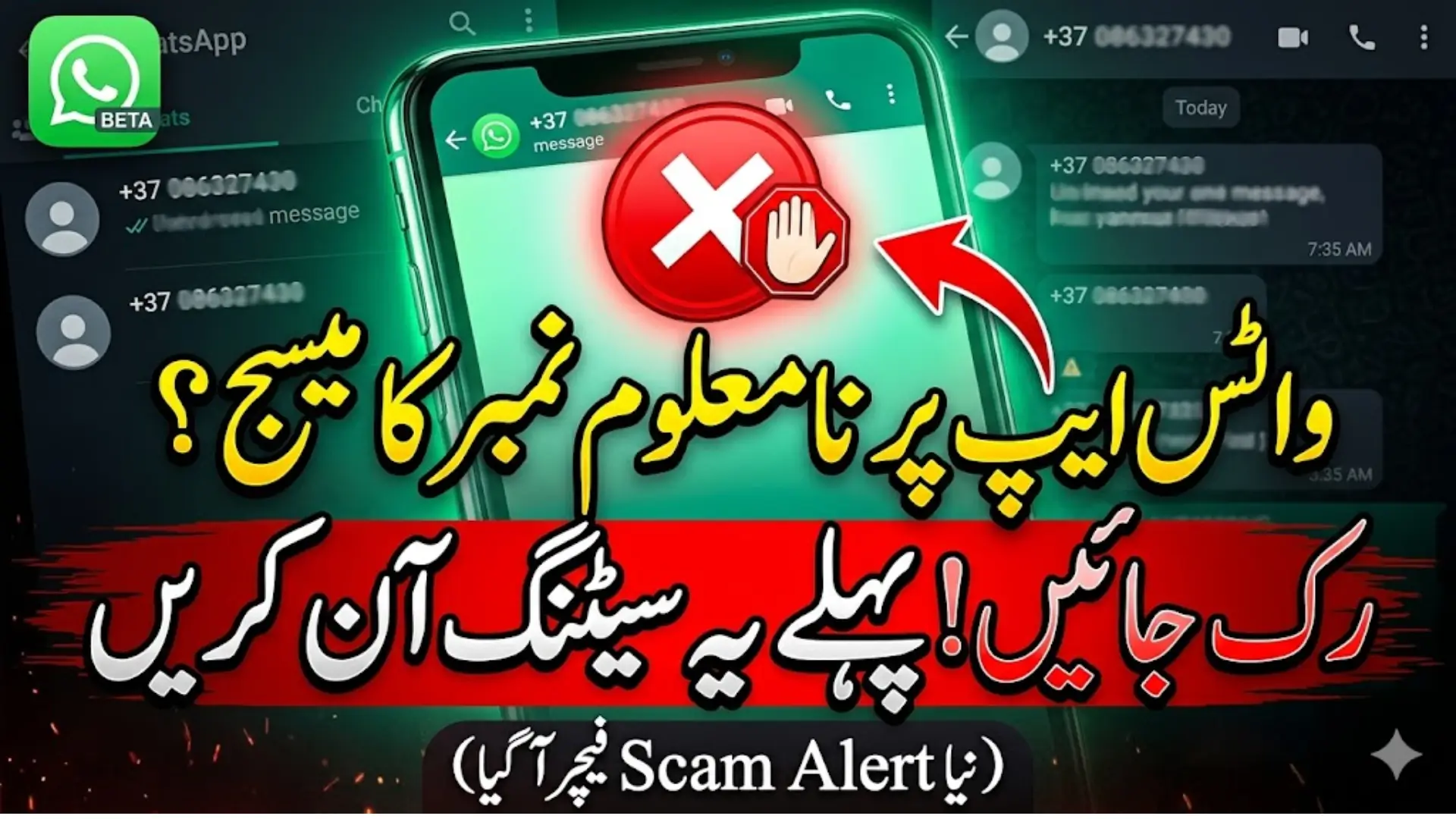
WhatsApp May Introduce New Scam Alerts
WhatsApp May Introduce New Scam Alerts: WhatsApp is quietly working on a powerful new security feature called Scam Alert, designed to detect suspicious messages from unknown contacts and warn users before they fall victim to fraud. Discovered in WhatsApp beta for Android 2.26.22.2, this feature represents one of the most significant steps the platform has taken toward proactive user safety without compromising its core privacy promise.

What makes this development particularly notable is that the entire analysis process runs locally on the user’s device. WhatsApp will not send any message content to external servers, keeping the feature fully aligned with the platform’s end-to-end encryption model. This approach mirrors how the app already handles voice message transcripts, where audio is converted to text entirely on the recipient’s device.
You Can Also Read: SBP Introduces Saudi Riyal and UAE Dirham Naya Pakistan Certificates
| Feature | Details |
|---|---|
| Scam Alert | Warns users about suspicious messages from unknown contacts. |
| Detection Method | Analyzes messages directly on the user’s device. |
| Privacy | No message content is sent to WhatsApp servers. |
| User Options | Block & report or continue the conversation. |
| Transparency Log | Stored locally on the user’s phone only. |
| Availability | Found in Android beta 2.26.22.2, not yet released. |
How On-Device Scam Detection Works
When an incoming message arrives from an unknown contact, WhatsApp’s Scam Alert system will automatically analyze the content directly on the user’s smartphone. If the message is flagged as potentially fraudulent, a warning will appear inside the chat interface displaying the text: “This may be a scam.” The system also highlights that the message originated from an unknown sender, giving users immediate context about the risk level.
Upon seeing the alert, users will be presented with two clear choices: block and report the suspicious contact, or trust the chat and continue the conversation normally. Importantly, the feature will not block communication automatically, preserving user autonomy. WhatsApp has not yet disclosed the full technical methodology used to identify scam patterns on-device, though the approach is consistent with modern privacy-preserving machine learning techniques.
You Can Also Read: Punjab Starts Grade 8 Student Registration Process for Annual Exams Session
Key Features of WhatsApp Scam Alert System
- Analyzes incoming messages from unknown contacts entirely on the user’s device without sending data to external servers.
- Displays a visible in-chat warning reading “This may be a scam” when suspicious content is detected.
- Gives users two actionable options: block and report the contact, or trust the chat and continue.
- Runs silently in the background and remains invisible to other users in the conversation.
- Keeps an on-device transparency log showing when and how the alert was triggered, never shared with WhatsApp.
- Optional and disabled by default, requiring users to manually activate it from WhatsApp settings.
Privacy-First Design With Local Reporting
One of the most compelling aspects of Scam Alert is its commitment to privacy at every level of its design. Because message analysis happens locally, WhatsApp itself will never read the content of user conversations to perform scam detection. The feature runs silently in the background, and other participants in a chat will not be able to tell whether the recipient has Scam Alert enabled or not.
WhatsApp is also developing a companion on-device transparency report specifically for Scam Alert activity. This log will document how and when the feature was activated, storing all records exclusively on the user’s phone. If no suspicious messages were detected within a given period, the report will reflect zero activity. If potential scams were flagged, those details will be recorded locally, giving users full visibility without any data ever leaving their device.
You Can Also Read: Balochistan Schools to Remain Closed for 5 Days on Eid ul-Azha
Privacy Commitments Built Into Scam Alert
- Message content is never transmitted to WhatsApp servers during scam analysis, protecting end-to-end encryption.
- The transparency report is stored only on the user’s device and is never uploaded or shared with WhatsApp.
- Other users cannot see that Scam Alert is enabled, ensuring no change in the chat experience for the other party.
- Users retain full control, since the feature neither blocks contacts automatically nor forces any action.
- Consistent with WhatsApp’s existing on-device voice transcript model, reinforcing a proven privacy framework.
- No third-party data processors are involved, keeping scam detection entirely within the user’s own hardware.
User Control and Optional Activation
Scam Alert will be entirely optional and switched off by default when it eventually becomes available. Users who want added protection against fraudulent messages will need to enable the feature manually through WhatsApp’s settings menu. This opt-in model ensures that people who prefer a completely unfiltered messaging experience are not affected, while those concerned about scam exposure can activate the layer of defense at any time.
This approach follows a design philosophy that WhatsApp has applied to similar features, such as voice message transcripts, which also require manual activation from settings. By keeping protective features opt-in rather than forced, WhatsApp acknowledges that different users have different needs, particularly in regions where unknown contacts from legitimate businesses are common.
You Can Also Read: LESCO Introduces Advanced System to Avoid Electricity Shutdowns
Release Date and Beta Availability Timeline
As of now, Scam Alert is not yet available to any users, including those enrolled in WhatsApp’s beta testing program. The feature was discovered embedded within WhatsApp beta for Android version 2.26.22.2, but it remains under active development and has not been enabled for testing. WhatsApp has made no official announcement about a planned release date.
Based on WhatsApp’s typical development cycle, the feature is expected to first reach Android beta testers through a future update before eventually rolling out to the stable version of the app. Whether an iOS version will follow simultaneously or arrive at a later date has not been confirmed. Users interested in early access can enroll in the beta program through the Google Play Store.
Important Points About Scam Alert Rollout
- Currently found only in WhatsApp beta for Android 2.26.22.2 and not yet enabled for any testers.
- No official release date has been announced by WhatsApp or its parent company Meta.
- Expected to debut in a future Android beta update before reaching the stable public version.
- iOS availability has not been confirmed and may follow the Android rollout at a later stage.
- WhatsApp has not released full technical documentation explaining the scam-detection algorithm.
- The feature reflects a broader industry push to address rising mobile fraud and social engineering attacks.
Why This Matters for Mobile Security in 2026
The introduction of an on-device fraud warning system positions WhatsApp ahead of many competing messaging platforms when it comes to protecting users without relying on server-side surveillance. With billions of active users globally, WhatsApp has become a primary target for scammers running impersonation schemes, fake job offers, investment fraud, and phishing campaigns. A built-in alert system that works without exposing message content offers a meaningful defense layer.
If Scam Alert performs as described in its current development stage, it could set a new standard for how encrypted messaging platforms handle fraud prevention. The balance it strikes between proactive user protection and strict data privacy is technically challenging to achieve and represents a significant engineering effort. Once released, it will be worth monitoring how accurately the system distinguishes genuine scams from legitimate messages sent by unfamiliar contacts.
You Can Also Read: Cross Subsidy Program Electricity Online Application Portal Temporary Down